Daily Stock Market Report (Fri 25th Sep 2026) - RBN, TND, FNX

Good Morning!
The Xi/Trump summit appears to be going well, with both leaders suggesting a new chapter in their friendship at last night’s state dinner.
Trump said: "We've never gotten along better". Xi urged both sides to explore a "new approach for major countries to get along". Most importantly, the key tariff truce has been extended until 10 January.
Brent fell as traders watch for signs the Strait of Hormuz will reopen. However, global bonds continue to sell off, with the US 5yr holding above 5%:
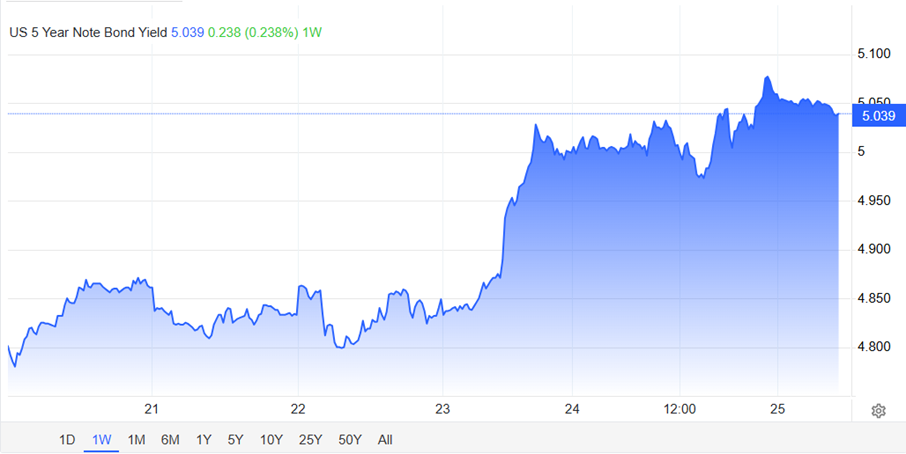
[Charts: Trading Economics]
And the UK 5-yr is pretty close:
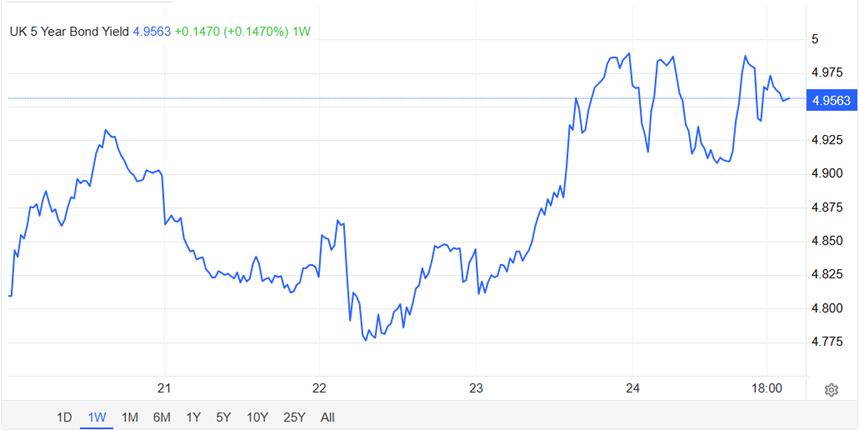
This is not welcome news for anyone coming off cheap mortgage fixes soon, and may be a major dampener on consumer spending.
Overnight market movements:
The FTSE is up 0.3% at 10,715
S&P 500 is up 0.1% at 7711
Brent crude (November) is down 2.0% at $99.05/bbl
Gold is down 0.1% at $4,271/oz
Bitcoin is down 0.1% at $84,224
Spreadsheet accompanying this report: link.
Report is complete.
Companies Reporting
| Name (Mkt Cap) | RNS | Summary | Our view (Author) |
|---|---|---|---|
United Utilities (LON:UU.). (£10.4bn | SR72) | Operational performance is in line with expectations, and delivery of our AMP8 capital programme continues to progress well, with projects advancing through the investment lifecycle as planned. We remain on track to deliver c.£2bn of capital investment in 2026/27 and c.£11.5bn across AMP8, supporting compound growth in our asset base of c.10%. Submitted response to the 2026 Cost Change Draft Decision, seeking support for c.£1 billion of investment. Continued constructive engagement with Ofwat ahead of the Final Decision in December 2026. | ||
Harworth (LON:HWG) (£582m | SR27) | 187 pence per Harworth Share | TAKEOVER | |
Avacta (LON:AVCT) (£349m | SR13) | Presentation of the FOCUS-01 trial design and preclinical data highlighting the potential of AVA6103 (FAP-Exd) in pancreatic ductal adenocarcinoma (PDAC). FOCUS-01 is the Phase 1 trial of AVA610 at AACR Conference on Pancreatic Cancer in San Diego. | ||
Ferrexpo (LON:FXPO) (£300m | SR39) | Revenue -57% to $196m, u/l LBITDA $4m, (25H1 $4m EBITDA). Has worked extensively to lower its costs to remain financially viable. | ||
Capita (LON:CPI) (£273m | SR19) | Entered into new financing facilities with Shawbrook Bank, comprising a £15m RCF and a £15m term loan. Three year term, maturing September 2029. £15m RCF is on substantially the same terms as existing £325m RCF, inclusive of the interest rate. The interest rate on the £15m term loan is modestly higher than on the RCF. | ||
Pensana (LON:PRE) (£213m | SR5) | Confirms $15m received from the State of Qatar to date and that construction at the Longonjo mine is now over 30% complete. | ||
Genel Energy (LON:GENL) (£176m | SR31) / Capricorn Energy (LON:CNE) (£282m | SR81) | Increased Offer of US$5.74 in cash for each Capricorn Share. US$4.75 in cash and a special dividend of US$0.99. | TAKEOVER | |
Savannah Resources (LON:SAV) (£150m | SR-) | Conditionally raised £2,192,628 in the Retail Offer through the issue of 39,865,966 Shares at 5.5p. Total gross proceeds of £30,088,587 raised through the fundraise. | ||
Strategic Minerals (LON:SML) (£147m | SR43) | Revenue -20% to $1.59m, LBT $712k (25H1: $568k PBT), Cash $10.03m (31 Dec: $7.104m) after ££8.7m equity raised in period. | ||
Aminex (LON:AEX) (£91.9m | SR11) | Revenue $14k (25H1: $17k), LBT $2.71m (25H1: $1.50m LBT). Cash $2.22m (31 Dec: $3.41m). | ||
Helix Exploration (LON:HEX) (£63.8m | SR5) | Six-month extension of the Sales Arrangement follows the initial three helium tube trailer sales to the Customer during Rudyard’s start-up phase representing Helix’s commercial debut in the helium market. | ||
Gemfields (LON:GEM) (£58.8m | SR28) | Reasonably certain that its net loss after tax will be $73.5m, driven primarily by a non-cash impairment charge of $125.2m. Adjusted headline EPS is expected to be 0.6c (25H1: -1.5c). | ||
Upland Resources (LON:UPL) (£51.1m | SR18) | LBT £3.0m (25H1: £1.1m LBT). Cash £2.09m (25H1: £0.69m) after a £3.2m net raise in the period. | ||
Bango (LON:BGO) (£47.4m | SR18) | Revenue +3% to $25.9m, Adj. EBITDA +34% to $9.0m. Net debt $8.7m (31 Dec: $9.2m). Trading remains in line with full year market expectations. (Revenue of $53.8M and adj. EBITDA of $19.5M.) | ||
Lendinvest (LON:LINV) (£40.7m | SR42) | Successful completion of its eighth Residential Mortgage-Backed Securitisation under its Mortimer programme, involving a £265m portfolio of 1,240 UK prime Buy-to-Let mortgage loans originated and serviced by LendInvest with an additional £35m of pre-fund. | ||
Abingdon Health (LON:ABDX) (£26.5m | SR29) | Official opening yesterday of its new manufacturing hub at the Company’s facility at University Research Park in Madison, Wisconsin. | ||
Wynnstay Properties (LON:WSP) (£24.3m | SR70) | Appointed Hugh Ford as Chairman Designate. | ||
Neo Energy Metals (LON:NEO) (£22.6m | SR28) | 269,230,769 new shares placed at a 18.75% discount to mid-market close, raising £1.75m gross. | ||
Robinson (LON:RBN) (£21.4m | SR78) | A significant customer contract (£3.3m revenue, £1.0m gross profit) scheduled to expire at the end of December 2026 will now not be renewed. At this stage, excluding the benefit of any such mitigations, the Board now anticipates that FY2027 profitability will be broadly in line with FY2026. | PROFIT WARNING/AMBER/RED = (Mark) | |
Great Western Mining (LON:GWMO) (£15.3m | SR23) | Loss €2.63m(25H1: €0.49m loss), including a revaluation loss on the share warrant provision of €1.86m | ||
Ondo InsurTech (LON:ONDO) (£14.3m | SR4) | Active LeakBots reached 172,862 at the end of August 2026, +34.8% yoy. Focused on converting commercial momentum into growth in recurring revenue. | ||
Thalia Therapeutics (LON:THAT) (£10.2m | SR14) | Has completed the initial chemistry synthesis of the siRNA gene-silencing medicines for its cardiovascular programme. In vivo work scheduled for later in the fourth quarter. | ||
Tandem (LON:TND) (£9.9m | SR93) | Revenue +6.7% to £11.9m, PBT £70k (25H1: £378k loss), EPS 1.3p (25H1: -6.9p). Net Debt £2.8m (25H1: £3.2m). | AMBER/GREEN = (Mark) Revenue is growing, and a return to H1 profitability is a good sign. However, an in-line statement (even with EPS from Cavendish upgraded due to a lower assumed tax charge) for the full year means they trade on a forward P/E of around 15. |
* Market caps at previous trading day’s close
Mark’s Section
Robinson (LON:RBN)
Down 6% at 120p (£21.4m) - Trading Update - Mark - AMBER/RED =
The last profits warning:
Although Robinson confirms that trading is in line for FY26, that isn’t necessarily good news. When the company released its interim results a month or so ago, it warned, saying:
The Board now expects underlying operating profit* for the 2026 financial year to be between £2.2m and £2.6m. Several pressures affecting the first half are expected to continue for longer than previously anticipated. The conflict in the Middle East has kept polymer, energy and freight costs elevated, and constrained material availability, while recovery through customer pricing remains uncertain.
They didn’t seem to want to give the previous guidance at the time, but their broker Cavendish soon revealed that this meant a 42% cut to FY26 Adj. PBT.
The scale of this miss is visible on the consensus trend:
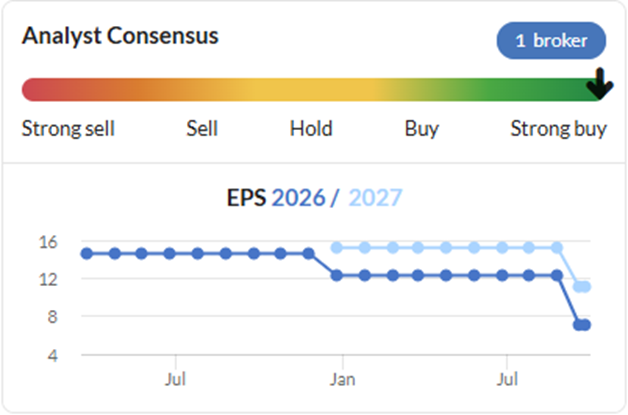
Cavendish also took 27% out of FY27 numbers at that time, showing there was no easy fix to their woes.
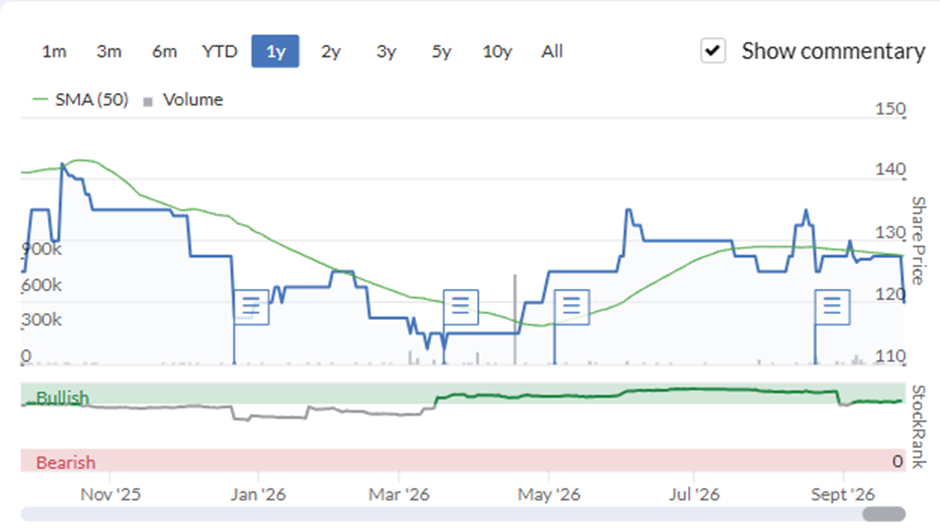
Strangely, the market seems to shrug off such a huge downgrade:
Today’s profits warning:
As many would probably already have guessed from the unscheduled Friday trading update, things just got a lot worse today:
A significant customer contract is scheduled to expire at the end of December 2026 and will now not be renewed. The Group retains a strong and ongoing relationship with the customer and will continue to supply a range of products across its factory network.
Helpfully, they quantify the impact:
The contract generated approximately £3.3 million of annual revenue and £1.0 million of annual contribution to gross profit, and in the absence of any offsetting actions would reduce FY2027 revenue and underlying operating profit* by these amounts.
They say they will try to cut costs to mitigate this loss, but if there was already a lot of fat in the business, they would have used it to offset the previous downgrade. The net impact is:
At this stage, excluding the benefit of any such mitigations, the Board now anticipates that FY2027 profitability will be broadly in line with FY2026.
I can’t see any updated coverage from Cavendish yet, but the impact is pretty clear. Broadly in line means a bit below, so perhaps we are looking at 6.5p EPS for FY27. This is a cut of almost 60% from where we started the year.
Valuation:
One argument for investing here was a strong FY27 recovery. However, recent updates have completely shot that in the foot. With the share price down only 6% to 120p, we have another year where the P/E is in the upper teens. This is the sort of multiple I’d expect from a tech company rapidly growing ARR and repeatedly beating expectations, not a plastic packaging manufacturer repeatedly missing them.
Perhaps what is supporting the price here is the dividend, where family ownership and the ongoing desire for an income means that 6p is forecast for the foreseeable future:
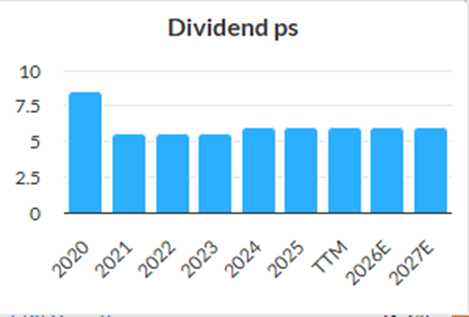
The interim dividend was maintained at the half-year, and they explicitly said they intend to maintain the 6p for the full year. However, net debt rose by £1m in the first six months of 2026, despite the sale of £1.5m of surplus properties.
Net debt increased to £6.4m during the period (31 December 2025: £5.4m). Cash outflows included £2.0m of investment in new plant and machinery (2025: £2.3m), a £0.6m dividend payment (2025: £0.6m) and a £2.1m working capital outflow (2025: £2.8m), partly offset by £1.5m of cash proceeds from completed property disposals. The Middle East crisis has increased input costs and constrained material availability, resulting in significantly higher working-capital requirements.
The other supporting factor is that the company trades at a discount to TBV:

£23.2m of that is PP&E, and the company has flagged further disposals of surplus property.
The sale of two other surplus properties in Chesterfield is agreed for £2.2m subject to contract, and they’ve given an option on Boythorpe Works for £2.85m. Together these would make a hefty reduction in net debt. However, a big question remains: will they actually complete? The market is valuing the consented greenfield land banks of many housebuilders at about 50p in the pound, given the housebuilding market backdrop. In the current environment, will buyers really rush to complete?
The biggest problem is how unproductive the remaining assets are. ROCE has been single-digit for as long as I can remember, and it won’t change significantly even if these surplus property assets are sold. In such circumstances, a company such as this should trade at a discount to net tangible assets, as these simply don’t generate an economic return in their current form.
Mark’s view
It seems crazy to me that the market hasn’t reacted more negatively here. We have now had two warnings that have collectively taken 40%+ out of FY26 EPS estimates, and maybe up to 60% out of FY27 EPS. Yet the market appears to have largely shrugged.
Given the severity of the downgrades, there is now a huge disconnect between the company's earnings and the value the market assigns to the business, making this materially overvalued IMO. For me to consider a manufacturer of single-use plastic packaging, something everyone is trying to reduce their use of, I would want a P/E at most in the mid-single digits, on a debt-free basis. Instead, we have a forward P/E approaching 20 and increasing net debt. Only the fact that they are still profitable and there is a discount to net tangible assets prevents a further reduction in my view. AMBER/RED
Tandem (LON:TND)
Up 8% at 195p (£9.9m) - Interim Results - Mark - AMBER/GREEN =
The market has liked these Interims this morning. These show revenue growing and a return to profitability:
- Group revenue increased 6.7% to £11.9 million (H1 2025: £11.2 million).
- Gross profit increased 15% to £4.0 million (H1 2025: £3.4 million), with gross margin increasing to 33.3% (H1 2025: 30.9%), primarily due to new products, categories and currency fluctuations.
- Adjusted EBITDA profit of £374k (H1 2025: £81k).
- Operating profit before exceptional costs of £220k (H1 2025: loss of £80k).
However, these are still relatively small amounts, so the market may be more buoyed by the strong late summer they have had:
Trading strengthened further post period end, with sales year-to-date to 30 August +9.1% ahead of the prior period.
This perhaps shouldn’t be surprising given the great weather we had, and their product set. Very hot weather wasn’t a panacea for all their categories, though:
Category
| Category | H1 sales growth | Sales growth to end of August |
|---|---|---|
Bike | 15% | 24% |
Home and garden | 76% | 52% |
Toys, Sports & Leisure | -13% | -13% |
Golf | -19% | -10% |
In very hot weather, not everyone wants to be doing energetic outdoor activities!
The net result is in-line trading for the full year:
Trading for the full year remains in line with market expectations.
The Board’s current intention would, on achievement of full year market expectations, be to declare a dividend in respect of the full year.
Forecasts:
We get an updated note from Cavendish in response, where they say:
We reduce our assumed tax expense for FY26E as Tandem makes use of a deferred tax asset, and we leave all other forecasts unchanged.
The result is a shift to 12.8p EPS, with a 3p dividend.
Valuation:
At the current 195p share price, the forward P/E is around 15, with a 1.5p dividend yield. I can’t help feeling this is pretty punchy for a distributor, where EPS has declined from the previous year. No one is holding this for the yield, either.
Net assets are roughly flat on the FY numbers at £26.1m or £20.1m excluding intangibles, tax assets and a pension scheme “surplus”.
This IAS19 surplus still required them to make £263k of defined benefit pension scheme contributions in this half. The Tanden triennial deficit at year-end, which determines actual cash payments, was around £700k. There is a separate Casket scheme in surplus by a similar amount, but they can’t offset one against the other, nor necessarily access any surplus.
Anyway, they said in the FY25 Annual Report:
The expected contributions in the year ending 31 December 2026 are £532,000 in accordance with the agreed schedule of contributions. The trustees and employer have agreed a schedule of contributions covering the period to September 2028.
Which means there is probably around £1m of cash contributions to me made to the scheme, before hopefully an updated valuation means that no further contributions will be necessary.
The net impact is that the real pro-forma TBV is around £19m. This is still around double the current market cap.
The problem is that these assets are unproductive, with the typical ROCE in low single figures. Clearly, shareholders are betting these assets will quickly become far more productive. Cavendish’s unwillingness to provide a FY27 forecast doesn’t give much confidence in this respect.
Strategy:
In a case like this, the strategy matters a lot. After the high demand for cycling and home products during COVID, they decided to build a large warehouse. But as demand normalised post-COVID, they’ve struggled to use the space effectively. This has driven a number of management changes:
CEO:
Jim Shears was CEO from August 2020, having been promoted from FD. He left by mutual agreement on 6 May 2022.
Steve Grant, the chairman, filled in as interim executive chair from April to May 2022.
Peter Kimberley has been CEO since May 2022. He was promoted from non-executive director.
Chair:
Steve Grant was chair until the AGM on 17 June 2026, having served six years. He was executive chair from April to June 2022 while the CEO role was vacant.
Jonathan Crookall was chair from 17 June to about 18 July 2026. He stepped down as chair after roughly a month and left the board on 10 August.
Mark Taylor was interim chair from about 18 July to 10 August 2026.
Simon Bragg has been chair since 10 August 2026. He is also the largest shareholder, with about 20%.
Until recently, the strategy was to acquire other businesses to add volume to their warehouse and make it productive. However, their net debt position appears to have prevented them from financing such a strategy, and presumably larger shareholders baulked at providing fresh equity to do so.
With the now largest shareholder taking the Chair role, this comes with a new desire for asset productivity, but without the acquisition focus:
Our priority is therefore clear: to accelerate profitable growth and improve Shareholder returns. Over the coming months, the Board will undertake a review of the Group’s operations, strategic priorities and capital allocation, with a particular focus on the initiatives most capable of driving sustainable sales growth, improving profitability and unlocking the value inherent in the business. We will update Shareholders as this work progresses.
This makes sense. However, it is not clear to me what exactly they can do to change this outlook in the current consumer environment. The risk is that at a 15x forward P/E, the market has already priced this as if they’ve achieved this improvement in the business, whereas in reality, it is still very much a desire rather than a reality.
Mark’s view
Graham rated this AMBER/GREEN recently, as he liked the property backing and clearly believes that it's only a matter of time before these assets are made productive again. I am a little more sceptical. While I recognise the scale of the discount to TBV opens up a lot of opportunities, they have been attempting this turnaround for a couple of years now with little traction. Perhaps Simon Bragg taking the Chairman role, and the size of his holding, means they are finally incentivised to really get on with it. The risk is that the current earnings multiple already prices in a significant recovery, and if it fails to happen, then the asset backing will not make any difference. Still, I can see the appeal for deep-value investors with very long-term investment horizons, so I won’t quibble over Graham’s previous view.
Backlog
Fonix (LON:FNX)
Down 2% at 199p (£198m) - Final Results - Mark - AMBER ↓
Like many similar companies, revenue includes a lot of pass-through, so gross profit matters more to shareholders. Here there is a decent 12.9% rise in trading. However, perhaps a little worryingly, the percentage changes go down as you go through the income statement:
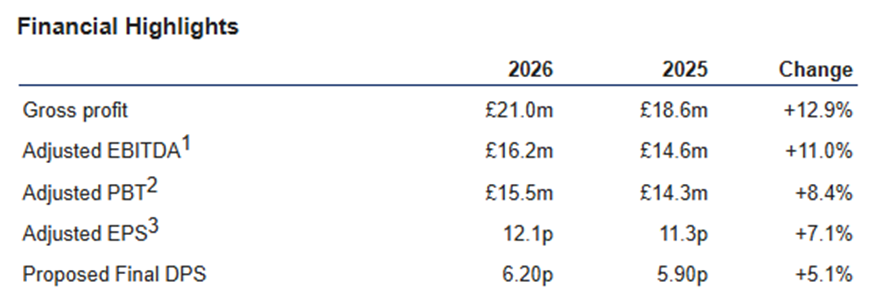
Investors much prefer the opposite and want to see positive operational gearing. Still, the company says that gross profit and adjusted EBITDA were "slightly ahead of market expectations".
This strength is said to continue:
Fonix enters FY27 with real momentum, building on a return to double-digit growth in FY26 gross profit and adjusted EBITDA, ahead of expectations. With Portugal now established, Switzerland live, France advancing, and a sixth market on the horizon, international expansion is fast becoming a genuine growth engine alongside the UK and Ireland. PayFlex, CompsPortal and RichMessaging are all gaining real traction, and increased dividends and buybacks reflect the Board's confidence in sustained, profitable growth ahead.
I'm slightly confused by the accompanying broker update from Cavendish, which says:
After upgrading FY27E and FY28E adjusted EBITDA by +2% at the July trading update, we reiterate FY27E and FY28E adjusted EBITDA growth of +9% and +11%, which reflects gross profit growth of +8% and +11%, and opex growth of +6% and +10%.
So that sounds like the company is trading ahead of its own expectations but not the markets, which already reflect that double-digit growth. Given these results appear to have caused a 12% jump in the share price, presumably because of these exact words, I think some caution is required:

Helpfully, Cavendish gives us their assumptions for opex growth, which this time is forecast to be below gross profit growth.
Valuation:
My other concern is that EBITDA is not a good measure of performance for a company that capitalises intangible spend. We should use EPS as our valuation metric for this sort of business. The forecast EPS growth from Cavendish is far more pedestrian:
- FY25 5.6%
- FY26 7.0%
- FY27 3.6%
- FY28 10.3%
This suggests that fair value should probably be closer to 10x earnings. The current forward P/E of around 18 makes the company look significantly overvalued compared to these growth rates.
However, EPS isn't everything. The company is good at converting EPS to free cash flow, and pays a 5% dividend:
The group maintained a strong underlying cash position of £9.4m at year-end, despite making additional distributions to shareholders during the year, including a £2.4m share buyback. The Board is recommending a final dividend of 6.20p per share, taking the total dividend for the year to 9.30p (FY25: 11.80p per share including the 3.00p special dividend), in line with our progressive policy of distributing at least 75% of adjusted earnings.
This is certainly what I like to see from a company: net cash and excess cash returned to shareholders with a 75% payout ratio, which is particularly impressive. However, I struggle to get excited about a forecast FCF yield from Cavendish of around 6%. And teh presence of a share buyback even at a relatively high multiple makes me wonder if they've drunk their own EBITDA Kool-Aid!
Cavendish comes up with a 300p price target, saying:
We value Fonix at 300p based on 15x FY28E EV/EBITDA or 4% FY28E EFCF yield, and it is currently trading on 12-month forward multiples of 9x EV/EBITDA with +9% EBITDA growth, 7% EFCF yield, and 6% dividend yield.
But again, I disagree with using EBITDA as a valuation metric, and a 4% FCF yield on 2028 numbers is less than UK bond yields. Of course, there is growth which you don't get from bonds, but growth isn't guaranteed.
Growth:
Geographic and service expansion gives them opportunities to accelerate growth beyond current forecasts and perhaps grow into their current valuation. However, a couple of forecast charts from Cavendish also raise some concerns for me:
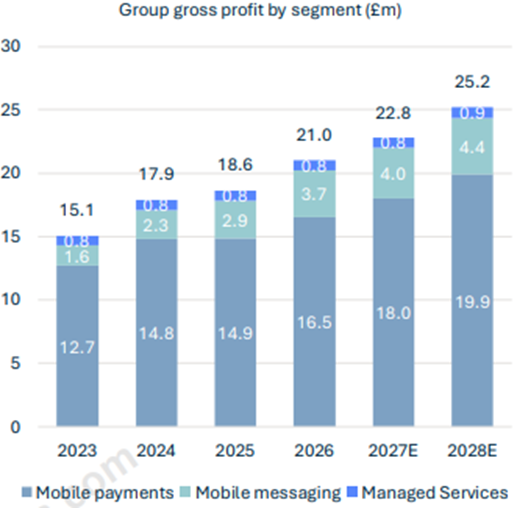
Mobile payments remains forecast to be the bulk of their gross profits:
As does the UK:
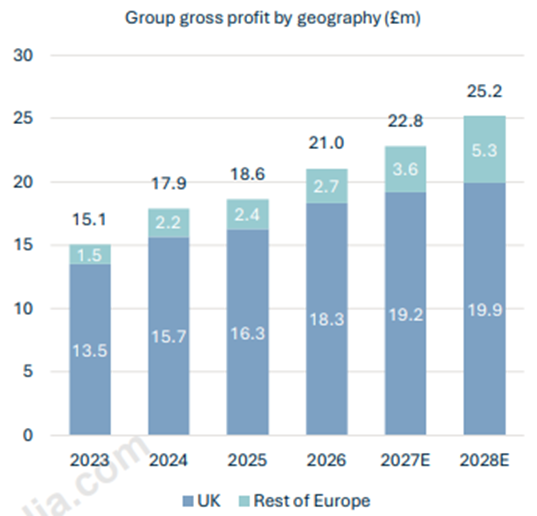
Investors have to be careful not to weigh their own experience too highly, and I may not be their target market, but I don't think I have ever used carrier billing, nor do I know anyone who regularly does. We are spoilt for choice in terms of payment options in the UK, so I wonder whether these payments could plateau or even decline over time. It seems more likely that carrier billing will grow in developing markets with fewer options. Fonix don't appear to operate in these yet.
Mark's view
Having not really looked at the company in any detail before, I expected to see a rapidly growing company that regularly trades ahead of expectations. However, after reading the Cavendish note, I come away questioning both assumptions. This certainly did upgrade slightly in July. However, the broker kept their forecasts unchanged in response to these results. The medium-term EPS growth rate of 6% is ok, but certainly not exceptional, and makes me question if it's worth paying almost 18x forward earnings for such a lacklustre bottom line.
It's hard to be too harsh on a company that generates free cash flow and returns most of it to shareholders as dividends, giving a 5% yield. However, for a company on a growth stock valuation, the EPS performance looks far too pedestrian:
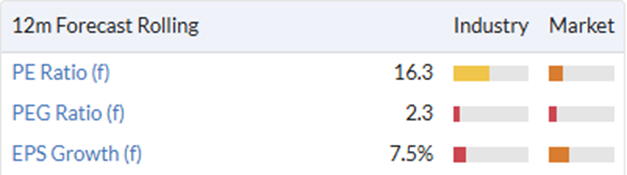
Graham recently rated this AMBER/GREEN. Still, with the share price almost 20% higher, including a 12% jump in response to the ahead/not ahead/ results, I think AMBER is probably closer to where we should be, at least until they can show that they can actually beat EPS expectations and accelerate bottom-line growth.
Disclaimer
This is not financial advice. Our content is intended to be used and must be used for information and education purposes only. Please read our disclaimer and terms and conditions to understand our obligations.

46 comments
Following Mark's special report on Wed last on @QTX I put my own comments rather late in the day, On the relatively quiet day of the week - Friday - in case anyone is interested and missed it, here is my own review to complement his: Thanks for the review Mark. You always cover the deep financials in a way that I can't.
I am a long standing shareholder and have been all over this share for some time. For everyone's benefit here, I have reviewed it on here and also on Paul Scott's show several time. The CEO (and only Board member currently) has been on Mello Monday twice in 2025 I believe and then the last one on the same platform by his two long standing Sales Manager and Finance Manager.
I'm interested in the two comments below. Especially the no directors buying and also the response to what I regard as a minor FRS discussion which changed little but seems to frighten people away. Strange, or maybe its me. There are no further directors, and there are significant founding holders, but only the CEO is the key top manager. Maybe the other commentators here thing the long standing other shareholders should be buying into weakness in the SP. I dont know.
The period when the CEO stepped away for the business for whatever reason was sour. The board at the time made a bog of it, bought a German competitor for too much, and screwed up the business in Germany. They probably didn't do much good elsewhere either, but Germany was the real mess. Andy Walters stepped back in - fired the board, got rid of their German acquisition for as little pain as he could, and then set about focusing on the rest of the business. It didn't take that long really fortunately which is an indicator for me of the guy's skills. He has put the focus very much back on the middle management team he left originally - Sales and Finance, and they are good. the French 4G was a necessary technical move, the cost was absorbed, and France continues to be a growing market.
Right, this is what I think. The UK market is very mature, and I am not sure how many businesses in their real target market - quite smallish businesses - are ready to spend right now. However, the £1/2m from all round cameras was successful, and there is little reason to think it wont be in France too.
I think that he is really interested in the hardware, and the results coming up are significantly cheaper product with enhanced performance though at Mello he still thinks the prime motivation is knowing what's happening to all their people and gear around the area/country. Nevertheless, value for money is big in this company's offering, that along with service - which bring us on to the business outside UK and France.
Spain and Italy are going great guns and that says to me that there is more to go at there, and that closer to home makes sense. There is Germany to rebuild, and then there is - for me - the rest of Europe. The installation offering is they will arrange it or the user can fit it themselves/with their choice of electrician - as I read it, and I guess that take quite a lot of handling and managing.
The US is another matter altogether. It goes without saying that it is potentially a temptingly huge market, but its also a long way away for a company which prides itself on its customer service. I guess they must have resellers there - you can find their website in the US if you want to with their case studies etc, just as you can find the French one too. I guess that the US is very tough to get off the ground, there is huge competition (I dont just mean in size - just a lot of it, whatever the niche they are looking for. If I remember rightly, there seems to be a small base on the east coast, and another in the mid-west somewhere - presumably separate resellers. A lot of much, much bigger companies have tried in the US - and failed, costly failures. So I'm not sure that the US promises to be the big growth area this company is looking for, if it has ever stated that in any accounts. Maybe Canada would be more interesting? Maybe I will drop Andy Walters a line if he feels the need to cross the Atlantic.
They have developed a robust and broad sales approach to the market opportunities, their so-called 4 pronged method.
1. using Price-Comparison Websites in the telematics sector, targeting SMEs.
2. Inside Sales (Telephone) The backbone of their direct channel involves their internal sales team that manages inbound leads (generated via digital marketing and price comparison engines) and performs outbound calling. Since Quartix focuses on simple, unbundled tracking packages, their inside sales agents can rapidly convert prospects over the phone using online demonstrations.
3. Indirect Channel (Distributors & Resellers) Quartix has a rapidly expanding international network of authorized third-party channel partners and resellers. This includes: Garages, workshops, and automotive service centres: Fleet leasing companies: Telecoms/connectivity providers and trade retailers. These partners bundle or cross-sell Quartix tracking hardware directly to their existing local commercial networks in exchange for a healthy commission structure.
4. Field Sales Teams. Reserved primarily for its larger geographic markets (such as the UK), Quartix These targeted representatives handle higher-volume commercial fleets, corporate clients, or specialized local tenders that require face-to-face negotiation, site alignment, and managed contract rollouts.
In summary, they have the new gear to relaunch with full scale production just in; they have the camera extension in France after a successful intro in the UK; they have great opportunities still in Spain and Italy. The UK market is tougher to find growth but lets see what the new models can do to re-stimulate the Sales force to go get it. I accept there is the concern about succession but when you see him perform in say Mello Monday, he is certainly a highly active 70s operator. Backing that up. he has the long standing Sales and Financial management team and the separate R&D development team to fall back on. I guess that he will be more careful about his choice of a Board this time if he chooses to step back a second time.
I had put on the same day some details of the international websites for the 6 different countries they trade in. However, it appears they have had a good look at what this is costing and the benefit it giving, and they have largely left those only as a means of contact by interested businesses with the company. For up to date responses they use largely Trustpilot - on which they score highly, by the way. The best website to get to the company for investors is as follows: https://www.quartix.com/en-gb/company/investors/
Hi
I commented on Mark's review and I bow to your clear intimate knowledge of the business. I feel the Keyman issue is paramount and it is just not for me. Happy if this goes well for investors who do not see this as a key risk. I would example Synectics (LON:SNX) where the founder died suddenly and momentum was lost despite there being other directors in place to manage the position.
Just for info, I’ve posted this via the green button:
I’m getting 404 errors on the links Charles Mitchell included in a post on the IT thread at 11.47.
Also today, the links there and in DMSR are opening directly and not in a new tab as I thought they were meant to ???
There's a work around until it gets fixed: when the error 404 appears, replace the 'www' in the URL by 'app' and it redirects successfully.
Robinson (LON:RBN)
My business looks over one of the many sites that Robinson owns in Chesterfield.
Many derelict, vast red brick industrial buildings left to rot.
The whole town can't wait for these to be sold off as they are an eye sore and can be utilised for so many other purposes (housing and commercial, obviously). There has been movement recently with the Chatsworth Road site being developed into a Starbucks (of all things! and some business units). So that's positive...
So reading that the business is struggling doesn't fill me with joy but if the family of shareholders want their divi they will have to put some more of these up for sale, which I wholeheartedly celebrate!
Kooth (LON:KOO) a stockrank jumper today: 67 to 97! Up on each of Q, V and M.
Good spot!
This is caused by the last set of interims being processed by the algorithms. Given H1 was weak on one-off marketing spend last year, the net impact is much better historical TTM financials.
The market wasn't a huge fan on the day, perhaps as there was a slight downgrade to FY26 EPS; however, it was accompanied by a 21% upgrade to FY27, showing some decent earnings momentum on lower cost assumptions, even if they don't win any additional states in the short term.
With net cash forecast to rise to £31m by the end of next year, which is more than half the market cap, this continues to look too cheap to me. I think one of two things happens: either they use that cash to acquire something complementary and scale more rapidly, or, more likely, one of the US telehealth companies acquires them once the details of the California contract renewal are announced. I'd imagine the major holders (such as ScaleUp and Rockwood/Harwood) would be amenable to an offer as long as the price began with a 3.
I hold, and am probably biased on this, though.
People with morgages today should have a look at a bit of history. -in 1990 they hit 15.4. I was paying 16.5% at one stage. We survived- just, though many houses were repossessed. 1% of owned properties so a total of 75000 homes. In 2026 as far as I can see 3840houses have been repossessed, so I would suggest at the moment. The figure for Q2 was down on Q1. I am not saying things are not difficult for many, but not in critical zone at the moment.
This was during the second Thatcher recession - the only time that house prices have fallen in absolute terms (rather than just relative to inflation) since 1945 - thanks to mismanagement by Nigel Lawson. A secretary at my work had to sell with negative equity and had to live in a room at her mother's with a husband and baby whilst they both worked hard to pay off their debt.
So, yes I agree, things could be a lot a worse but it's still tough on those coming off 5 year fixed mortgages having to renew at much larger interest rates.
"People with morgages today should have a look at a bit of history. -in 1990 they hit 15.4. I was paying 16.5% at one stage."
And during the 1970s the inflation was also circa 25%. As Charles said, we survived.
The repossession rate is interesting but not the first indicator of a serious problem on the horizon.
One of the first indicators I would look for is loan delinquency. Lenders with excessive exposure to second charge mortgages will probably be most affected so I monitor those lenders quite closely.
Also, it is helpful to keep track of valuers and how they are responding to market conditions.
Not critical, yet, but our mortgage about to go up around 250 a month next year, currently on 1.75%
I know my daughter and son-in-law in a similar position. I have been encouraging them to overpay. They are not 100% onboard with this as they can make higher returns elsewhere, but given they pay the high tax rate they are overpaying and it does make a big difference over the length of a mortgage. I overpaid ours - we had a mortgage in our 50's (2005)as we had to move from a joint owned family property on the death of a relative. I overpaid and it made a big difference. We were lucky that my wife then sold her retail business and we paid it off. Another friend who buys and sells properties thought we were mad and we should have geared up !.The experience of the 1990 made me not keen on that idea!
I think the issue these days is the much wider gap between property prices and wages - people have to stretch themselves much more now than in the past, so even a 1 or 2 % rise in interest rates makes paying the mortgage much more of a struggle - add in the ever increasing utilities bills and fuel price increases and you can see why the economy remains sluggish.
I hear this- but I was paying 70% of my (low city at the time) wages in rent at one stage. And the mortgage-large I admit- took a huge chunk. Looking at my two daughters and seeing that age out and about in Bristol and Manchester I am not sure it is that much harder. They do try and convince me otherwise! Of course we did not have all the subscriptions to TV, Phones etc so maybe that is a part of it. I could never quite afford a flat- when I earned £2k the cheapest was £6k, £3k and they were £7k and so it went on. Until the boom years in the mid-80's.
Banks did not lend that high a ratio to salary. On the other hand the Banks would let you overdraw to stag a new issue- an easy way to earn a few pounds though we were always scaled down hugely!
Maybe I am just sounding my age !! That is worrying.
Don't worry Charles I remember three tv channels and mother getting the candles out when the electric went off in winter (a lot of the time from memory).
I'm just hoping someone invents time travel before I shuffle off I will be heading back to 1985 with a suitcase full of downloaded Stocko naps rec's since inception and the penny share guide end of year results for the time before Stocko must remember to buy Next when it nearly went bankrupt.
Phoenix- now that would be a trading opportunity !
I find it strange that nobody ever seems to mention the obvious - entitlement and expectations. Due to a change of employment we moved and had to endure the crazy mortgage rates of late 1980's. Yet we coped.
Mortgages were set at more realistic levels back then - 3.5 - 4.5X joint income. It was a stretch but it was do-able.
BUT, and this is a big BUT, we had little or no furniture or it was second hand until we could afford new. We didn't have a foreign holiday once or twice a year. We didn't have the latest iPhone. We had an old car. We didn't get our nails done every week. We didn't have a Starbucks coffee everyday. We didn't have monthly subscriptions for Netflix etc etc. We didn't .................. Well, you get the picture.
So, I for one don't have a lot of sympathy for anyone that has maxed out their mortgage, got loans on all the new furniture and new car, has the latest iPhone etc etc. You cut your outgoings to match what can afford - not whinge because you can't afford a coffee every day and your nails to be done only once a month.
Tin hat on!
Excellent post!
All the best
its so true - i pointed out all the things that were way more expensive back in the day to a guy on tick-tock and all he could do is say - well car insurance is more expensive in real terms now - i suspect you can get a washing macchine almost as cheap nowas as you could in the 80's.
back in then 80's dole queue was double what it is now - many had to move to get a job - its noty nice that some may need to move away if they want a home - i wish they would do more for affordable housing for long term locals in expensive areas - but facts are there is still dirt cheap accom if you "ainta posh snob" in many parts of the area - in my town the average house price is perhaps now 350-400k - go to next town down the road and there is a boat load of stuff at 40k waiting for a buyer !!!
Back in the day many who had kids tended to have on parent who worked overtime or had second job - how many of the moaners today would be willing to go an ddo their 20 hours at night and over the weekend - to get up in life.
a young couple if they put in 55 hours a week for a year atr say £14 quid an hour tyhat would pull in 80k top line - thats not bad starting point if you dont mind doinga bit of graft to get on.
dont get me wrong i get thats its tough - but their vision of the 70's 80's and 90's being loads of money is just plain wromng for most of the country that werent lucky enough to be yuppies.
The problem is that there are now many many adults that:
So pretty much, we have a big chunk of adults making investing decisions, mortgage decisions.... all without first hand experience of those major shocks above....
Been subscribing for a while but this is my first post on here...
Read the Robinson (LON:RBN) piece today with interest, since I'm wrestling with a similar-shaped question on a different name.
Judges Scientific (LON:JDG): 23 Sep interims, H1 revenue -21%, adj. PTP -75% (offshore wind/US research funding/China procurement headwinds), but FY26 guidance maintained, interim div raised 10%, and only -1.8% share reaction on the day. My instinct was to read that muted reaction as "already priced in" from the July warning, but this RBN piece just talked me out of trusting that instinct on its own.
- QR87, currently ~74% below Berenberg's 5,600p target (held unchanged post-results - though that's already down from 12,400p thirteen months ago, so "unchanged" is a low bar, not a fresh vote of confidence).
- FCA net short's been declining since May (3.03%→1.67%). CFO leaving but on 12 months' notice, orderly.
Unlike RBN there's no TBV or property-disposal story propping this up that I can see: it's a straight quality/growth re-rating question. Still genuinely torn between "cyclical headwinds, guidance held" and "still catching a falling knife four days post-print, muted reaction notwithstanding."
Anyone followed this one through the last few quarters — does 3,480p (52w low) look like real support, or are we just waiting for the next leg down?
It is a good day to add Bango to the line up at MelloLondon and we now have 39 companies already signed up to present to hundreds of investors
We're delighted to announce that LSL Property Services, Tristel, Burford Capital, Bango and The Property Franchise Group will be joining us at MelloLondon! Between them they cover property services, infection prevention, litigation finance and digital commerce, so investors will get a varied line-up with something to interest everyone.
Stockopedia subsceibers can use the code Stocko25 for 25% off General Sale & Final Release tickets: https://www.melloevents.com/mellolondon2026
See you in November for Mello London, it is going to be an excellent two days for investors - Mello really is a very open and welcoming investor community so do join us!
David
Hi Mark, just noticed the wrong ticker for UPL above which probably explains your comment. It should be Upland Resources (LON:UPL) thanks.
Thanks, the link is now corrected.
This wasn't the problem this morning, as the link in the RNS took me to the Upland Resources website.
It may be that I was just being dim, and when I clicked through, I had to scroll down to try to find the interim results. However, the last thing investors (especially those trying to quickly summarise the day's news!) need in the 7 am RNS feed is a click-through to the website and then a careful search to try to find the results.
The cynic in me wonders whether they weren't keen for investors to see they burnt through £1.8m of cash in H1 and only have £2.1m left in the bank, despite a £3.2m net raise in H1!
Interims for Upland Resources (LON:UPL) are on their website.
I note Marc Brunner of Lost Soldier Oil and Gas (who are invested in UPL and vice versa) is meeting with UPL this weekend in Ireland to discuss progress on the many opportunities in South-East Asia. Hopefully UPL can provide an update on this "exciting news" which Marc stated on his webcast last night (seems to have been promised for some time though...)
https://upland.energy/financial-reports/
Tandem - get on yer bike
Not bad but yet again not good
Circa 12 million turnover to make 70 grand profit despite owning its own supposed world class warehouse (thats where the cash went)
Interesting net assets up 2.something million , not sure where that comes from, as theres no retained profit (im not an accountant so might be talking rubbish.
Bottom line remains
- 33% margin is too low
- overhead too high
70k a year is what 2 people get stacking shelves at tescos
I once turned over 22 million at Planet X and made 30k profit and had a really bad but really expensive FD who had a 5 million “balancing figure” .
Then I very fortunately found a world class FD with enough stamina to put up with my erratic non neurotypical madness, he found the triggers to educate and motivate me (he basically used to give me short term targets and not realising i was a labrador who liked a pat on the head really transformed)
His words to me
“Margin too low
Overhead too high
Stock too high
Cash too low
Lets fix those”
3 years later margin up 10%, sales down 30% , overhead down 40% , stock down 50%, cash up (from -2 million in special measures at barclays to plus 2million on the beach in barbados). And pound for pound we reckoned the most profitable and efficient bicycle company in the world .
Tandems problem is margin, 33% isnt enough, they are a middle market box shifting distributor.
Tandems opportunity which theyve had for years and done nothing about is to become a real brand / company not a box shifting wholesaler mentality
They keep missing golden opportunity to grow by acquisition, Frog , Raleigh if it was available would have been the golden ticket .
Simon Bragg is good for them as chairman, he seems a very good addition and is putting his cold hard cash down I think thats why they have sharpened up a bit.
Just a pity they wont (maybe unable to as no headroom) roll the dice.
My suggestion is pick up a market leading brand in distressed state , and give it a bit of love and if they do a great job that lifts margin . Executiin risk is 30/70 so not easy .
Or just carry on producing nothing for shareholders except in good years and nothing in tough years .
But not terrible just same old
Tandem (LON:TND)
Interesting net assets up 2.something million , not sure where that comes from, as theres no retained profit (im not an accountant so might be talking rubbish.
yep your presumption at the end is correct - i am guessing you made the mistake of comparing to the adjacent numbers which was as at 30/6/2025. the end of the last period was the 31/12/2025 - so you need the numbers on thne extreme right - compared to 31/12/2025 net assets the value has only increased by 50k - not 2 million something.
just echo yesterdays comments - nice to have you back and commenting in your colourful and frank way!
Good to have you back. I always enjoy reading your posts!
Mark, any chance you could circle back and have a look at Fonix (LON:FNX) who reported earlier this week. A positive statement for future in several european countries.
I hold
Sure, I don't see why not.
Thanks Mark
3P
you may well have watched this IMC presentation re their recent results, but if you or anyone else hasnt I feel it is worth an hour of your time. I found it very informative and thought Fonix (LON:FNX) management a class act.
https://www.youtube.com/watch?v=e-nTavooJms
Helvellyn
Yes I did watch the webinar. Thanks for advice
It is interesting the US 5Y is now higher than the UK - I have been watching 10Y yields and the premium of the UK is falling... which I think is a positive for UK equities. Of the small list I follow only Australia is higher but France is rising quickly and the additional yield in the UK has fallen from 90bp to 40bp in a few weeks ( France rising more quickly - but all yields are rising). Sterling has made a little progress recently and with any luck this will continue. Sterling up, yield premium down is broadly good for UK equities I "guess" .... the US 10Y is currently favourite to overtake the UK but France is not far behind.... the downside being the positive trend in yield is less positive for leveraged assets like property.
Perhaps of greater immediate concern than rising yields is the prospect of a diesel shortage. France is already seeing rising numbers of petrol stations without diesel.
There are calls in the U.S. to implement an export ban on diesel to try and bring down the local cost. If that happens, how would the U.K. replace the 15% or so of its supply that comes from there?
I noticed yesterday the price for diesel has gone over £2 a litre locally.
This is surely going to have big knock on effects throughout the economy?
The UK and Europe won't physically run out of diesel—the market will ration through price. Europe will outbid regions like Latin America and Asia for non-US cargoes from Middle Eastern and Asian refiners.
The market balances in 2 ways:
If it really happens get ready for deisil at up to £2.50 a litre.
The the only reason America will ban exports of diesel is for internal political purposes - trump trying to no lose the midterms. This will help some parts of Southern US (where the exprts come from) but the usa is a *big* place and the northern US is closer to world prices.
Crude will be found but think refiners will be running at full capacity. Heard of VanEck Oil Refiners ETF (PCQ:CRAK) who hold Valero Energy (NYQ:VLO) Marathon Petroleum (NYQ:MPC) both who have already 'pumped' higher, so maybe have missed the 'tanker'.
Par Pacific Holdings (NYQ:PARR) looks interesting.
Will research some Europeans over the weekend, not the UK although the two usual suspects Shell (LON:SHEL) and BP (LON:BP.) seem ok and have options.
You might like to look at Repsol (MCE:REP). Covers most of the upstream to downstream elements and only gets around 10% of it's crude from the middle east. I hold.
https://www.stockopedia.com/a/share-prices/safestay-LON:SSTY/news/01a0d727-b02c-7cb9-8489-38179c4bdc78
It looks like your morning sweep has missed Safestay (LON:SSTY) interims.
Too small probably. Mcap is only £8m.
Yes, excluded for size. We tend to have a £10m cut-off to avoid commenting on very illiquid stocks. I let Tandem squeeze in at £9.9m, as we've written about it in the past.
Thanks Mark, I didnt realise there was a lower limit.
Even smaller now, shares are down 20%.
I think the concern is that we could move the market in microcaps. However, in this case, the losses, high debt and declining forward bookings have already moved it!
In the US a small-cap is $250 - $2b dollars. Ok knock off a bit for FX.
A micro-cap is $250m
A nano under $50m
Some downside:
Volatile, lower liquidity, less coverage, sensitive to rates, recessions etc, high risk and speculative. But we know that - still sitting on some genius IPO's post covid.
Personally just scroll past anything under 50m even the miners as highly specialist and super risky.
Easy to suck up a story, harder to ignore.