Why the US is the place to be

I've spent the best part of a decade looking at the UK market and have almost given up. The reasons are well rehearsed so I won't go into them again.
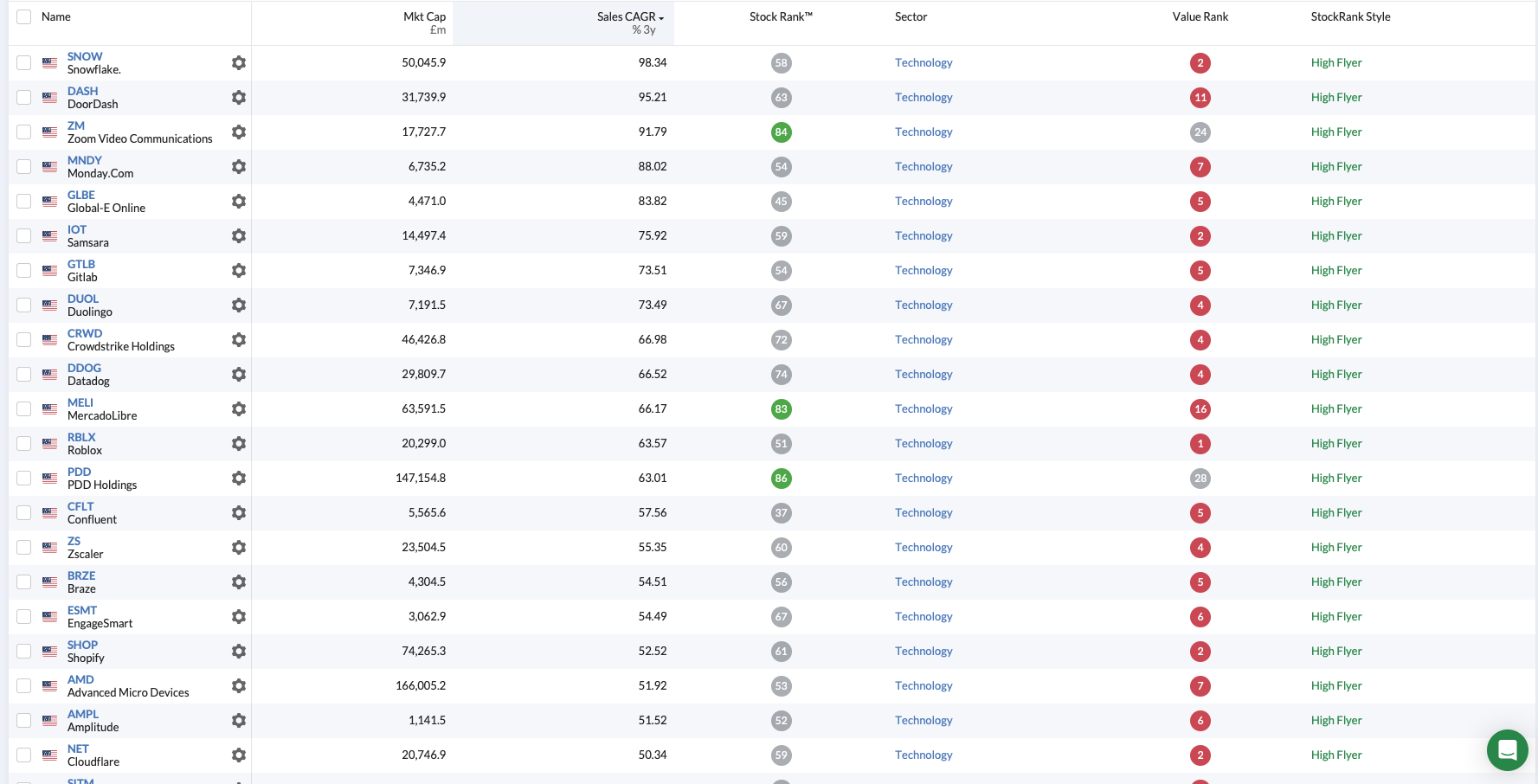
Stockopedia does cover US stocks and it is well worth looking at some of the simple data for US companies. I've made a very simple screen just focussing on companies with a Sales CAGR of over 30% for 3 years, a market cap above $1billion and in the technology sector. These are the fastest growing companies in the fastest growing sector. There were 56 results: this is the first page. This is the screen sorted by CAGR.
And then the same screen sorted by YTD returns on the share price.
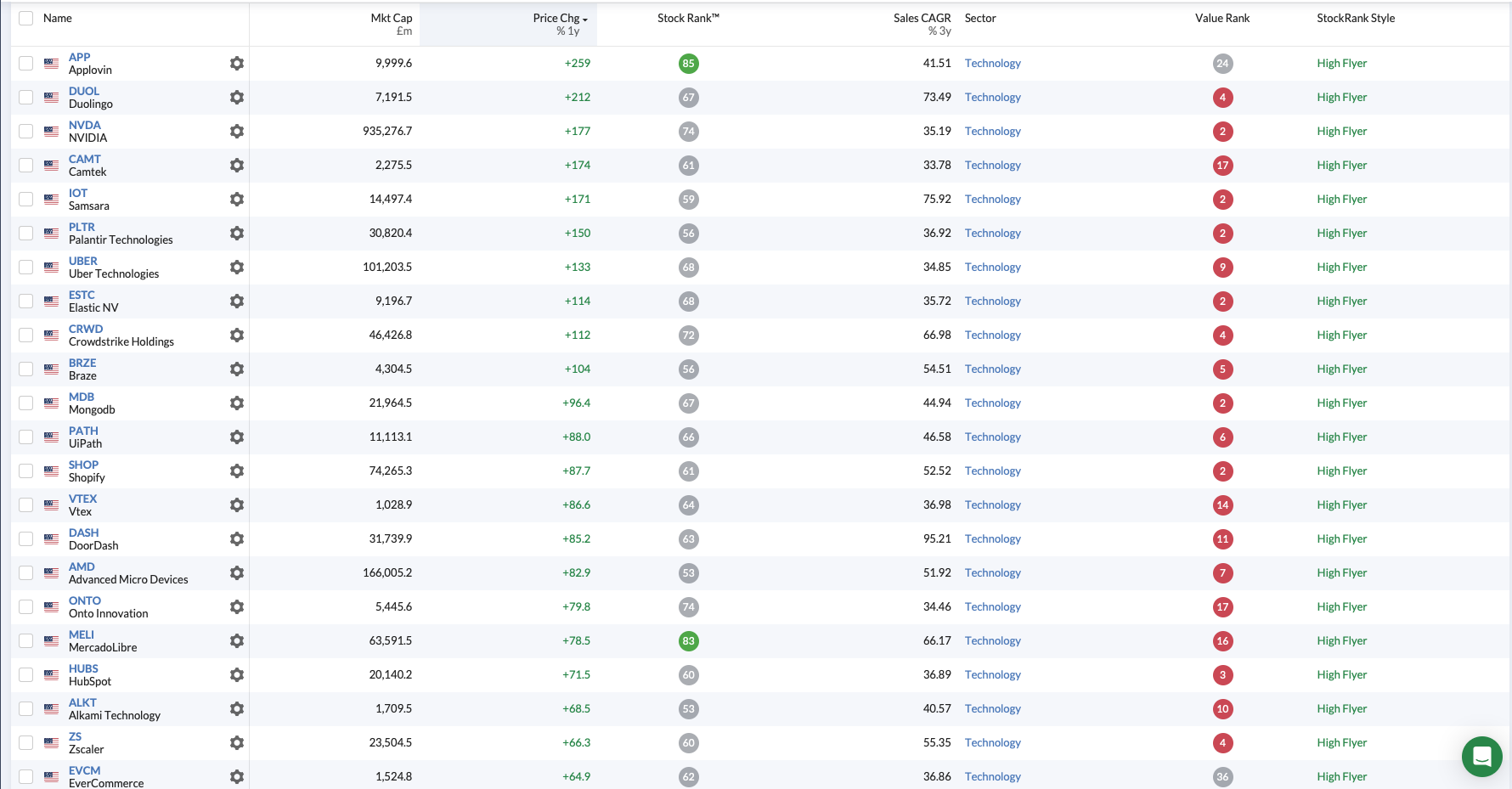
It is important to highlight that these are all large, very liquid companies. If you want to trade or spread bet them, the costs of doing so are marginal. Some of them are going to be the household names of the future.
I have done a similar but less selective screen for UK stocks: sales CAGR above 30% a year for 3 years, market cap above £200m and positive SP over 12 months. This is what comes back.
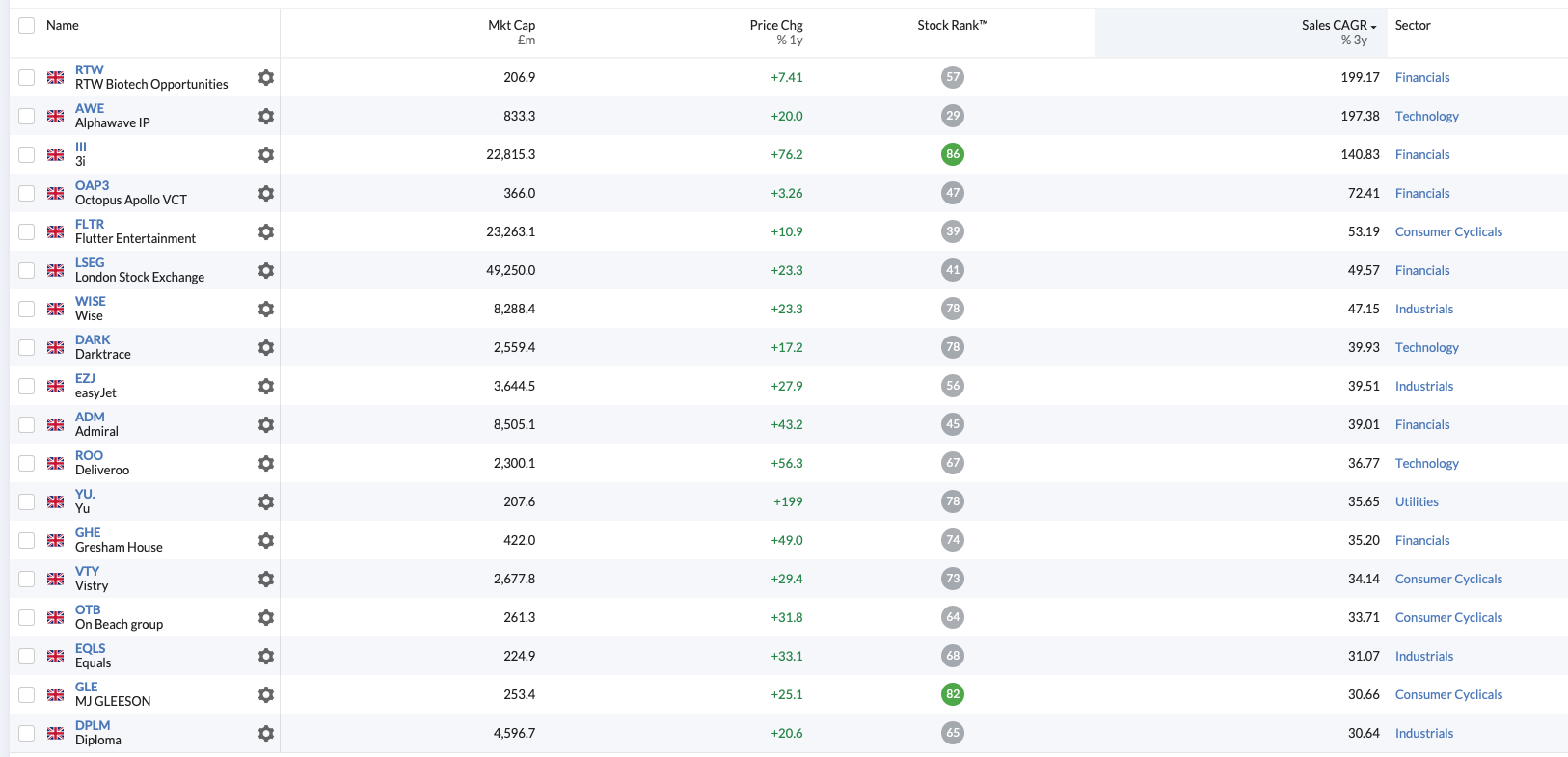
A total of 18 results, and 3 of the first 4 are collective vehicles where the figures on CAGR may not be very dependable.
There will of course be market cycles, and there will be a time when beaten up insurers and housebuilders do well. However, I can't help feeling that over any sensible timescale the US companies are the ones that you want to be invested in. And that is before you consider the liquidity of the US market: if you want to trade in and out you can do so at marginal cost and with minimal spreads.
Coming back to Stockopedia after a spell away and reading the message boards I am surprised at how much focus there is on the UK market. Yes, the US market is expensive. But companies growing at 50% a year always will be. These are companies providing global services in high growth areas. Perhaps they are all in a massive bubble. But as PIs don't we have the advantage of being able to sell quickly if the markets turn over?
Finally, remember that the US market in particular is largely fed by employees putting their retirement plans into trackers. For as long as more people are employed and paying into schemes than are retired or unemployed and pulling money out, there will be a general tailwind to the market. And US demographics, unlike many other countries, are entering a favourable period for the next decade. Yes, a recession looks likely next year. But it is surely the place to be.
Disclaimer
This is not financial advice. Our content is intended to be used and must be used for information and education purposes only. Please read our disclaimer and terms and conditions to understand our obligations.
15 comments
Completely agree Donald. The UK market is very sluggish compared with the US, and the spreads on smaller companies are ridiculous. There are a couple of good companies like Yellow Cake (LON:YCA) (I hold) but not much else to get excited about. Advanced Micro Devices (NSQ:AMD) looks about to take off (I hold). Vanguard S&P 500 UCITS ETF USD Dis (LON:VUSA) is a well respected tracker fund for US companies and avoids FX and stamp duty.
Here are a list of largely ETF's that I am either invested in or closely watching.
It also includes a couple of IT's and a couple of UT's which although expensive for the UT's I consider their performance record to justify the high HL costs.
I have also included my UK and Global lists as well - the Global ones have a lot of US stocks which often means they are very similar to the US ETF's.
The UK choices are limited and I haven't really done too much research into other options (especially UT's) as I tend to use single company shares for my UK investments. There is a new UK ETF (dividend & quality focussed) which I quite like on the list.
Many of these ETF's were looked at and bought to my attention by Ian Shadracks videos on you-tube which often does some excellent comparisons of IT's & ETF's.
I haven't got round to putting the volatility scores in yet.
US;
Global;
UK;
I updated all of the performance figures yesterday so they should be current.
The blue means I am invested in or are preferred choice. Grey means it is closed to new investments (unfortunately).
My colour coding on returns is related to what I consider to be a good return - 6%+ for 1 year, 30%+ for 3yrs and 60%+ for 5yrs, but you will no doubt all of your own views on this.
Great stuff, Kevin. If I was going to pick the best all around fund and if I had to only invest in one I'd go for GGRG. I too am a fan of Ian Shadrack's channel.
UC99 is my favourite US fund due to it being the only one (that I am aware of) that has a quality filter without sector neutrality.
Thanks Kevin, I think your list of the ETFs and funds that you like is very useful.
If one is keen on US technology shares, there are two global investment trusts with excellent past performance records, both long-term and short-term, which invest mainly in US technology shares and are on historically high discounts to Net Asset Value of about 13% at present and may be worth considering. They are Polar Capital Technology (PCT) and Allianz Technology Trust (ATT). Their performance records can be seen on the AIC website:
https://www.theaic.co.uk/compa...
https://www.theaic.co.uk/compa...
Thanks pka they are the 2 ITs I have been looking along with JPMorgan American Investment Trust (LON:JAM)
Hi SC120
I think that pka has answered the question. Both of the selections are good choices for US tech. If you look at the discount to NAV graphs, you will see that the discounts were historically much narrower.
JP Morgan American is a bit more of a generalist Trust. If you like the idea of growth then it might be worth keeping an eye on SMT which was a great favourite of the private investor. Recently its unquoted portfoio has nudged its 30% ceiling and it is 10% geared. Both of these factors have probably played a part in the discount going to circa 12% when for many years it had a small premium.
I don't do ETF;s. I like the idea of picking entry points on ITs (and prefs). It is a steady, if unspectacular investment theme which has worked well over the years.
A brief follow up to my own post as I was interrupted on the original post.
I think its important to check the IT KID document and I never assume that I know everything about an IT from previous experience.
As mentioned above SMT has a US bias but has a large part of its portfolio in unquoted stocks. Following the Woodford affair I think that such unquoted stocks have been viewed more critically when held in an IT. This is probably why SMT is rated 6 and towards the higher end of the risk scale.
As with individual shares, ITs need the usual DYOR caveat.
Yes, I agree. The UK has structural economic problems and I've diversified into the US to mitigate the UK's post-Brexit economic decline.
You made an interesting point about US retail investors putting money into the US index funds, boosting their returns. This is a chronic problem in the UK and is a leading reason why the UK has a liquidity problem. Last year according to the ONS, there is £300bn sitting in Stocks and Shares ISAs and a further £250bn in Cash ISAs. However, up to 70% of the Stocks and Shares ISAs capital is sitting in globally diversified index funds (mostly the S&P500). If this money could be diverted back into Britain, it would give our markets a boost and give British companies access to much needed capital to grow and innovate. Pension funds are doing something similar too.
Do I blame retail investors for it? Absolutely not. Most retail investors want a passive, easy solution to investing and the S&P500 / Nasdaq-100 have hugely outperformed the FTSE. It would be great if we could create a new British Growth Index, one with lets say, 30 liquid FTSE350 companies which are high quality, high growth... maybe something similar to the FTSE Techmark AllShare Index but as a buyable ETF.
Another reason is the UK's risk appetite and heavy focus on dividends and profit generation at a very early stage. British investors tend to punish companies that are running at a loss, even if revenues are growing (e.g. Oxford Nanopore Technologies (LON:ONT). Dividends are also a problem, because payouts don't directly go back into the market. In the US, they opt for a policy of share buybacks which further inflate the share price.
Hello Paul, good to see you back. Are you still working for Phoenix Copper (LON:PXC) ? Any info you'd like to add to the discussion you started a couple of years ago?
I will do on that thread this weekend.
The US has by far the greatest concentration of well capitalised innovative companies. And investing history shows that innovation is the driver of returns - the reason why earnings in a market like the US continuously grow ahead of GDP and inflation, and the reason why market leadership changes over periods greater than a decade. By contrast, the UK market has very few innovative companies, and those that thrive are swallowed up well before reaching large cap status. It should be no surprise that the UK market shows anaemic earnings growth and an almost non-existent churn of market leadership.
Anyone who avoids the innovation engine that is the Nasdaq is going to have to work very hard - to say the least - to generate comparable earnings growth in their portfolio. And the only possible reason not to invest stateside is a fear that its valuation must fall dramatically. But for how long have UK investors used this excuse not to take the plunge? And how many times has the Nasdaq multibagged since the argument was first trotted out?
Those that eschew international investing believe they are incurring fewer risks. That might be true for US domiciled investors with their well diversified, globally exposed, innovation-heavy market and safe haven currency. Are they fretting about paying 20x earnings for proven winners? But for us in the UK, I believe that the big risks are being taken by those who do not diversify in currency and geography.
An interesting post. Hopefully it will get some comments.
The US has some other advantages in addition to those mentioned. The US private investor has more choice with fractional shares and dynamic rebalancing. I dont use these, so I cant speak from personal experience, but they are clever marketing which no doubt encourages more people to try regular investing.
Its difficult to see where the UK market might go. It could gradually get smaller and cheaper as the UK loses its influence - or it could be seen as very cheap at some stage and undergo a revival.
Its worth mentioning that if someone wants to start investing in the US there are a number of collectives traded in the UK which could prove to be a useful starting point. As mentioned on other threads, Investment Trust discounts are looking quite interesting at the moment.
I would be interested to hear views on ITs and ETFs with exposure to the US. Invesco QQQ Trust Series 1 (NMQ:QQQ) is an ETF on my watchlist. I am investigating ITs and trying to balance performance and current discount to NAV.
Yes impressive charts. I've spent the last 20 years avoiding the US as overpriced and missed out on lots of big wins.
However! The US economic position is now woeful and it does feel as though there could be a big correction still coming, especially for the frothy stocks. I would look again at that time but for now feel much more comfortable in value territory, and nowhere is quite as lowly valued as the UK.