3 FTSE 350 value stocks with 5%+ yields

After a short-lived Santa Rally at the end of 2023, market conditions seem to have calmed down again. Most of the main UK indices have made a somewhat downbeat start to the year:

At home and abroad, there are clearly plenty of plausible reasons for investors to be cautious about the year ahead.
Despite this, I think there are also some reasonable arguments to suggest that many UK equities offer a decent mix of value and medium-term growth opportunities at the moment.
I would not necessarily describe myself as a glass half-full person. But I am feeling relatively optimistic about the investment opportunities within the universe of shares I follow.
One reason for my enthusiasm is that in an era of 5% risk-free interest rates, I can still find plenty of well-respected FTSE 350 stocks offering yields in excess of 5%, with added growth potential. For me this looks potentially attractive, in terms of valuation.
As evidence of my conviction – rightly or wrongly – I am almost fully invested in my main personal portfolio. My rules-based SIF folio here at Stockopedia is also more heavily invested than it has been for a while.
In the remainder of this piece, I’ll highlight some stocks that I believe have the potential to deliver total returns (dividends plus share price gains) comfortably ahead of the 5% risk-free rate.
Finding opportunities
As is my habit, I’ve used Stockopedia’s screening tools to build a simple screen to help me find shares that might be of interest for further research.
Here are the rules I’ve used. I’ve deliberately kept this very simple in order to (hopefully) provide a decent number of sensible choices:
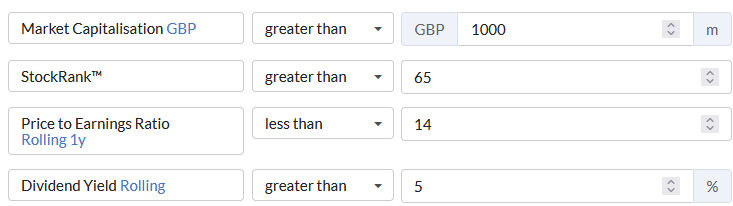
You can see or copy this screen here
This screen generated 32 results at the time of writing. Here they are:
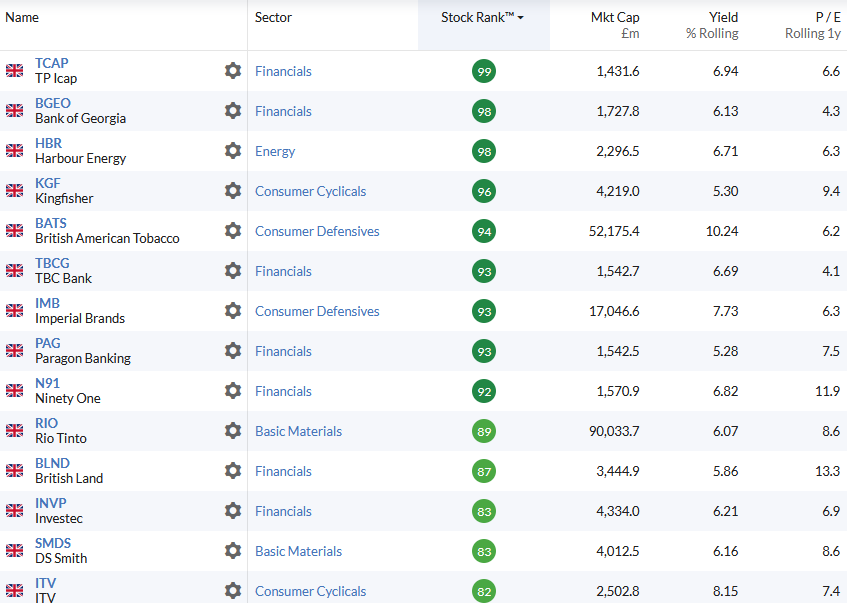
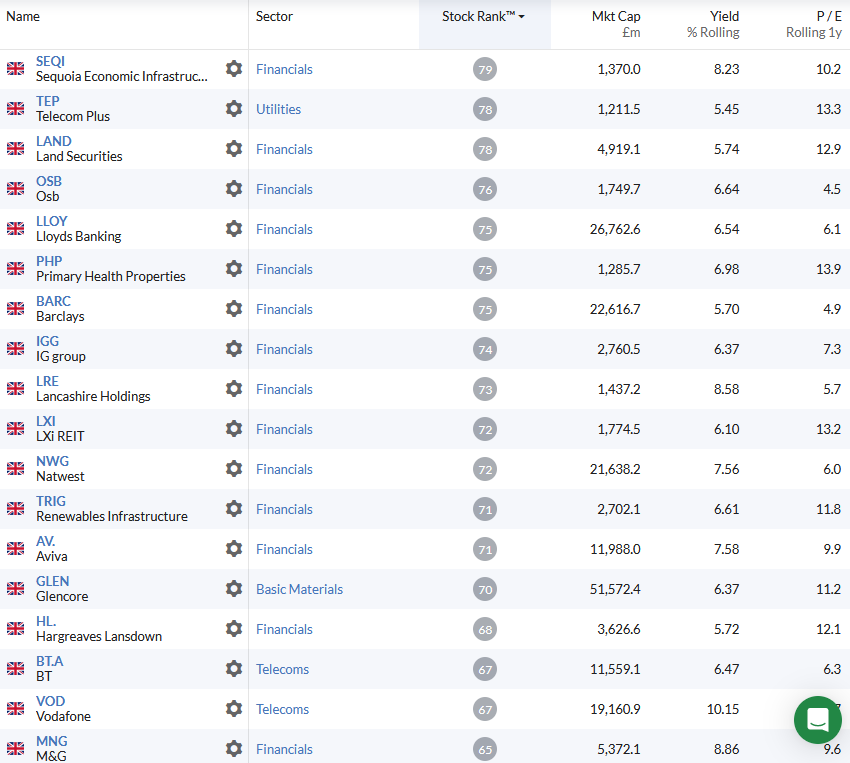
Let’s take a look at a few of these.
I notice Harbour Energy (LON:HBR) near the top of the list. I covered this oil and gas stock in a recent in-depth Stock Pitch. My view on this stock can probably best be described as mixed – but check out my piece for yourself here.
In any case, Harbour is not quite the kind of company I’m looking for today. I’d like to find businesses with a longer track record as a consistent entity – and ideally, a little more future certainty.
In the remainder of this piece I’ll highlight three shares I think have the potential to deliver high yield and steady growth over the coming years.
Kingfisher (LON:KGF)

Kingfisher is the owner of B&Q, Screwfix and similar businesses in France and Poland.
This business is clearly more cyclical than the big supermarkets. However, I think it has some qualities that could make an interesting choice at current levels.

Kingfisher’s operating margins have averaged about 6% in recent years, compared to c.3% for J Sainsbury (LON:SBRY) and Tesco (LON:TSCO).
While some of the group’s DIY brands are struggling with weaker cyclical demand, Screwfix is continuing to grow strongly. B&Q’s trade offering is also said to be doing well.
Financially, Kingfisher has a track record of good cash generation and tends to end the year with a net cash position, excluding lease debt.
Right now, Kingfisher shares look cheaper than I have seen them for a long time, trading at 0.6x book value, or just over one times tangible net asset value.

This valuation seems to have triggered some institutional interest, as well. Noted value fund manager Silchester International Investors is currently the group’s largest shareholder, with a 13% holding according to Stockopedia:

I think the main risk here is that economic conditions will get worse – in the UK or France. In addition, this business has historically sometimes struggled to perform well in all of its main markets at once, resulting in a somewhat mixed record of long-term growth.

Kingfisher shares currently trade on a forward multiple of 10x earnings, with a 5.4% yield covered c.2x by earnings.

Based on my view that we’re probably getting close to the bottom of the economic cycle, I think the stock could be worth a closer look at current levels.
Telecom Plus (LON:TEP)

Telecom Plus is probably better known through its main operating business, energy supplier Utility Warehouse. This unusual business doesn’t advertise, instead recruiting customers through a large team of self-employed agents.
The other unusual thing about the business is that it offers multiple services through one bill – electricity and gas are the core offerings, but mobile, broadband and more recently home insurance are also available.
The group’s energy is bought under a long-term agreement with E ON SE (ETR:EOAN) that provides good visibility on pricing and allows the company to price just under the UK price cap.
Now that some kind of sanity has returned to the UK utility market – following the failure of many sub-scale suppliers – Telecom Plus’s offering has become highly competitive again.
The company claims to have been the cheapest energy supplier for new customers for much of 2022/23 and has delivered standout growth during this period. Customer numbers rose at an annualised rate of 14% in H1 last year, while adjusted pre-tax profit jumped 36%.

I can’t help being instinctively cautious about the business model of this group. It is, essentially, multi-level marketing. But Telecom Plus has been trading successfully in this way for around 25 years and has never cut its dividend.

I don’t see any obvious reason why the company cannot continue to be successful.
In addition, Telecom Plus shares have pulled back significantly from the record highs seen during the 2022 energy crisis:

I think the stock now looks quite reasonably priced, with a useful 6% dividend yield:

In my view, this business offers an attractive balance of risk and reward for investors at current levels. I think it has the potential to provide steady incremental growth over the coming years.
DS Smith (LON:SMDS)

Like Kingfisher, FTSE 100 packaging group DS Smith is a cyclical business that’s suffering from weaker end markets at present.
I wrote about this business in more depth in a Stock Pitch in December 2022. With hindsight, I was a little early, but I think the attractions I discussed then remain true now – with the added attraction that the stock is now a little cheaper!

In recent years, DS Smith has focused on consolidating past acquisitions and improving profitability. Return on capital employed has reached double-digit levels and broker forecasts suggest this will be sustained:

One weakness of this business may be its heavy weighting towards FMCG customers – consumer goods companies.
These businesses are obviously exposed to a slowdown in consumer spending. Sure enough, DS Smith’s like-for-like volumes fell by 5% during the six months to 31 October. Operating profit for the period fell by 13%.
Broker forecasts suggest 2023/24 will be a low point for profits, with a gradual recovery from 2024/25.

With the stock trading on less than nine times earnings and yielding 6%, my feeling is that the cyclical downside risk is already priced in here.

I could be wrong, of course, if macro conditions become much worse than currently expected. That’s a decision for individual investors to take – in reality, it’s hard to invest in cyclical stocks without taking at least some view on where we are in the economic cycle.
As always, please let me know what you think about the companies I’ve discussed and your views on the wider issue of how to balance income and growth in a portfolio. There’s no single right answer here, and I always find it interesting to see how other investors approach this issue.
Disclaimer
This is not financial advice. Our content is intended to be used and must be used for information and education purposes only. Please read our disclaimer and terms and conditions to understand our obligations.

8 comments
MNG is a favourite of Lord Lee, BTW.
Interesting Legal & General (LON:LGEN) were looking attractive to me in terms of big cap safe yield. Am surprised they did not appear on the search results. The seem to fit all the criteria (I think) although I could not find the Yield Rolling data on the Stockreport page!
The Stockrank is too low. Not that higher Stockranks have stop others on the list falling. I do hold Legal & General (LON:LGEN), Phoenix group (LON:PHNX) and Aviva (LON:AV.) which is on this screen. If you copy the screen, then you can put a stock not on it and see why it does not qualify.
Thanks Rusty don't know how I missed the stockrank
Roland has set a filter for StockRank greater than 65 and Legal & General (LON:LGEN) (which I hold) has a SR of 46 which is why it doesn't feature. Insurers are difficult to value because the rules changed recently greatly reducing declared profits when new policies are written. You can see this in the accounts for 2022. I think the case for investing in the likes of Aviva (LON:AV.) and Legal & General (LON:LGEN) would need another article.
Hi Roland
Good article. It would be useful in your article to know where those selected above are in the Corporate cycle of declaring and paying their dividends, just as part of your summary.
I might be tempted by making an investment in DS Smith, so will look into this further.
Regards
If you go into the "accounts" tab at the top of the page and then go into "dividend summary" it will show you its past history in a simple bar chart and in a table on the right hand side it will give you the ex-div date, the payment date, the div per share and tell you if it is final/interim/special.
It even tells you about declared dividends that haven't ben paid yet. There is a huge amount of info to allow self-serving on the stock site.
Thanks Kevin. I am aware there is info in the stats (others may not though), just that in an article about divs I think it is particularly important to highlight the corporate cycle, particularly if you are not a hugger and holder for long-term, where clearly, all things being equal, or better than equal, you get the advertised yield playing out.
I have given you a thumbs up as this was not intended as a riposte.